

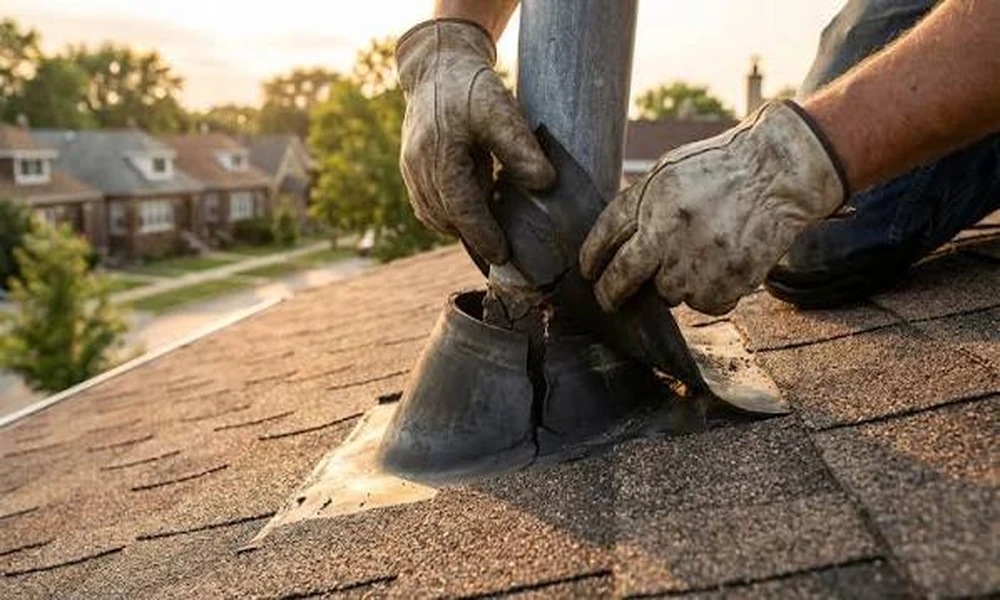
At some point, every homeowner stands in the driveway looking up at the roof and asks the same thing: do I patch it or start over? Contractors will give you an opinion, neighbors will give you another, and your budget will give you a third. It is easy to feel stuck between them.
The good news is that this decision usually comes down to a handful of questions. Answer them honestly and the right path tends to reveal itself. This guide walks through five of them in the order that makes the most sense.
Question One: How Old Is the Roof, Really?
Age is the first filter, but it needs context. Roofing materials have very different lifespans. Asphalt shingles, metal panels, tile, slate, and flat membrane systems each age on their own timeline, and climate, sun exposure, and ventilation can speed up or slow down that clock.
Start by finding the installation date. Check your closing documents, old invoices, or permit records with your local building department. If you bought the house used and nobody knows, a professional can often estimate age from the condition of the material.
How to use the answer: A roof in the first third of its expected life is almost always a repair candidate. A roof near the end of its life makes repairs a short term bet, because fixing one area often reveals trouble in the next.
Question Two: Is the Damage Local or Widespread?
Picture two roofs. On the first, a branch fell and cracked a few shingles near the edge. On the second, shingles across every slope are curling, cracking, and shedding granules. Both have damage, but they tell completely different stories.
Localized damage from an identifiable event is usually well suited to repair. Widespread wear is a sign that the material itself has reached its limit.
Walk the ground around your house and look at the gutters. A large amount of granules collecting in them, along with curled or cupped shingle edges and bare patches, points toward an aging roof rather than an isolated problem.
How to use the answer: Isolated damage on a healthy roof favors repair. Damage that shows up everywhere favors replacement.
Question Three: How Often Have You Already Repaired It?
Think back over the last few years. Has the same area been patched more than once? Have different leaks appeared in different spots? Each repair costs money, and a pattern of repeat visits is data.
A single repair is a fix. Three repairs in two years is a trend. When repairs stack up, the combined spending can approach the cost of a new roof without delivering any of the benefits, such as a fresh warranty or improved performance.
If you are weighing this question for your own home, speaking with a local roofing company in Chambersburg can help you see whether recent problems are connected, since an on-site inspection often reveals patterns that are invisible from the ground.
How to use the answer: Occasional repairs on a sound roof are normal. Frequent repairs on an aging roof suggest it is time to put that money toward replacement.
Question Four: What Is Happening Underneath?
The surface is only the visible layer. Beneath it sit underlayment, decking, and the structure itself. If moisture has been getting in, those hidden layers may be damaged even when the shingles still look acceptable.
Signs of trouble include sagging sections, soft spots when walking the attic floor near the roof deck, dark stains on the underside of the sheathing, musty odors, and daylight showing through the boards. Any of these suggest the problem extends beyond a few damaged shingles.
This is the question where a professional inspection earns its keep. A contractor can examine the attic, test for moisture, and tell you whether the deck is solid enough to support a repair or needs to be opened up.
How to use the answer: Dry, sound decking supports a repair decision. Damaged decking usually means a larger project, because the underlying wood must be corrected for any new roofing to last.
Question Five: What Are Your Plans for the House?
This question is about you, not the roof. How long do you intend to stay? Are you preparing to sell, or planning to live there for another twenty years?
If you plan to sell soon, a modest repair that addresses a specific issue may be sensible, especially if the roof is otherwise serviceable. Buyers and inspectors will take note of condition, and the right choice depends on your local market and timeline.
If you are staying long term, replacement can offer better value over time. A new roof comes with a fresh warranty, better protection, and the chance to improve ventilation, insulation, and energy performance while the work is underway.
The ENERGY STAR program offers helpful information on energy efficient roof products, which can be worth reviewing if you are leaning toward replacement and want to understand your options.
How to use the answer: Short horizons favor targeted repairs. Long horizons favor investing in a full solution.
Putting Your Answers Together
Once you have worked through the five questions, step back and look at the overall picture.
If your roof is relatively young, the damage is limited, repairs have been rare, the decking is sound, and your plans are short term, repair is likely the practical choice.
If your roof is old, the wear is widespread, repairs keep recurring, there is evidence of moisture below the surface, and you plan to stay, replacement is probably the wiser investment.
Most real homes land somewhere in between, which is why a professional opinion helps. Bring your answers to the conversation. A contractor who sees that you have already done your homework will give you a more useful assessment.
Questions to Ask the Contractor
When you get a professional evaluation, ask these.
- What is the condition of the decking and underlayment?
- How much useful life do you estimate remains in the current roof?
- If we repair, what is the expected lifespan of the repair and what could go wrong?
- If we replace, what is included in the scope, and how is rotted wood handled?
- Can you show me photos of what you found?
- What would you do if this were your own house?
The last question often produces the most honest answer.
Common Traps to Avoid
Repairing out of fear of the bigger bill. Sometimes avoiding replacement costs more in the long run.
Replacing out of pressure. A contractor who insists you must replace the roof immediately, without showing evidence, deserves a second opinion.
Ignoring small leaks. A little water inside is a sign of a larger problem above.
Making the decision during an emergency. Whenever possible, evaluate before something fails, so you can compare options calmly.
The Bottom Line
The repair or replace decision feels overwhelming because it combines money, risk, and uncertainty. Breaking it into five questions makes it manageable. Know the age, judge the extent of the damage, count your past repairs, look beneath the surface, and be honest about your plans. Then bring in a professional to confirm what you have found. With those answers in hand, you will not be guessing, and you will be ready to choose with confidence.